

29 Jan 26
Demand Response and HVAC: How Smart Control Supports a More Stable Grid
If you care about sustainability, power grid stability, or even your own electric bill, you’ve probably encountered the term “demand response.” Demand response programs are becoming a key part of how utilities manage peak electricity demand, especially as homes and buildings electrify and HVAC systems become a larger share of total energy use.
This guide explains what demand response is, why HVAC systems play a central role, and how the right control strategy determines whether demand response actually delivers benefits for both the grid and the customer.
What is Demand Response?
Demand Response (DR) refers to programs that temporarily reduce or shift electricity consumption during periods of high demand. When electricity use approaches the limits of generation or transmission capacity, utilities risk grid instability, brownouts, or outages.
Demand response helps prevent these scenarios by allowing utilities or authorized aggregators to reduce non-essential electrical loads in a controlled, automated way—without interrupting critical services.
How Demand Response Works
Demand response programs for residential and light commercial customers are typically run directly by the utility. For residential and light commercial customers, most demand response programs are opt-in programs offered by the utility (sometimes in partnership with a third-party aggregator).
The basic workflow of a demand response program looks like this:
- A customer enrolls an eligible device, such as a smart thermostat, water heater, or EV charger.
- The utility monitors grid conditions.
- During periods of peak demand, a demand response event is triggered.
- Enrolled devices temporarily reduce or shift their power use.
The result is short-term grid relief that helps avoid outages.
Customer Incentives
Customers who enroll in a demand response program may be eligible for rebates, bill credits, or “time-of-use” savings from utilities that use “critical peak pricing” to charge more for energy during peak usage. Different utilities offer different incentives, but the bottom line remains the same: enrolling in a demand response program saves customers money on their energy bills.
Better grid stability for the utility, cheaper power for the customer: enrolling in demand response is a win-win.
Why HVAC is Central to Demand Response
Not all electrical loads are suitable for demand response. Utilities cannot simply shut off refrigerators, medical devices, or lighting without causing serious disruption.
Demand response relies on flexible, high-impact loads: systems that draw significant power but can be adjusted temporarily without harming comfort or safety.
Why HVAC Is Perfect for Demand Response
HVAC devices like smart thermostats are central to many utilities’ demand response programs. Why?
- Impact: During peak demand in the summer, cooling can represent more than 70 percent of electricity demand. The popularity of heat pumps is increasing HVAC power draw in the winter too: by 2050, more than half of heating installations will be heat pumps. Reducing HVAC power consumption during DR events has a significant effect on grid stability.
- Control: HVAC controls are more sophisticated than a lot of other devices in the home. A DR event doesn’t have to turn the unit off: it can just adjust the setpoint.
- Comfort: If your home or office is already a comfortable temperature, you may not even notice if the temperature setpoint is changed for an hour or two during a DR event. As a result, HVAC systems can “store” energy by pre-cooling or -heating a space.
These factors make HVAC the perfect target for demand response: it makes a big difference for the grid without causing significant discomfort or inconvenience for the customer.
Does Demand Response Work with Any HVAC System?
The connection point between an HVAC system and a demand response program is usually the control layer (like the smart thermostat or the home/building automation platform) rather than the HVAC equipment itself. For demand response to work, you need compatible controls at two different stages: between the utility and the smart thermostat, and between the smart thermostat and the HVAC unit.
Smart Thermostat and Utility Compatibility
Most utilities publish a list of compatible smart thermostats. Leading third-party smart thermostats like Google Nest, ecobee, and Honeywell Home are usually eligible, but check with your specific provider before purchasing: there’s no universal list.
During a DR event, the utility sends a signal to the thermostat’s cloud platform, which then issues control commands (such as a temporary setpoint adjustment) to the device.
However, this is only half the equation.
Smart Thermostat Compatibility with Inverter HVAC Units
Installing an eligible smart thermostat gets you halfway there. Now, you need to make sure your smart thermostat can send commands to your HVAC unit with no loss of functionality.
Modern Inverter HVAC units (including VRF systems, mini-splits, and heat pumps) rely on proprietary manufacturer protocols and can’t communicate directly with third-party control devices like smart thermostats or home/building automation platforms.
If you connect an Inverter unit directly to a smart thermostat, it loses its variable speed functionality and falls back to single-speed operation. That negates the value of demand response: researchers have found that single-speed HVAC systems can actually draw more energy ramping back up after a DR event than they save during it.
For customers, this can mean higher bills and more discomfort during DR events. For HVAC installers, it can mean angry calls during every heat wave.
Aidoo Pro for Smart Thermostat Integration
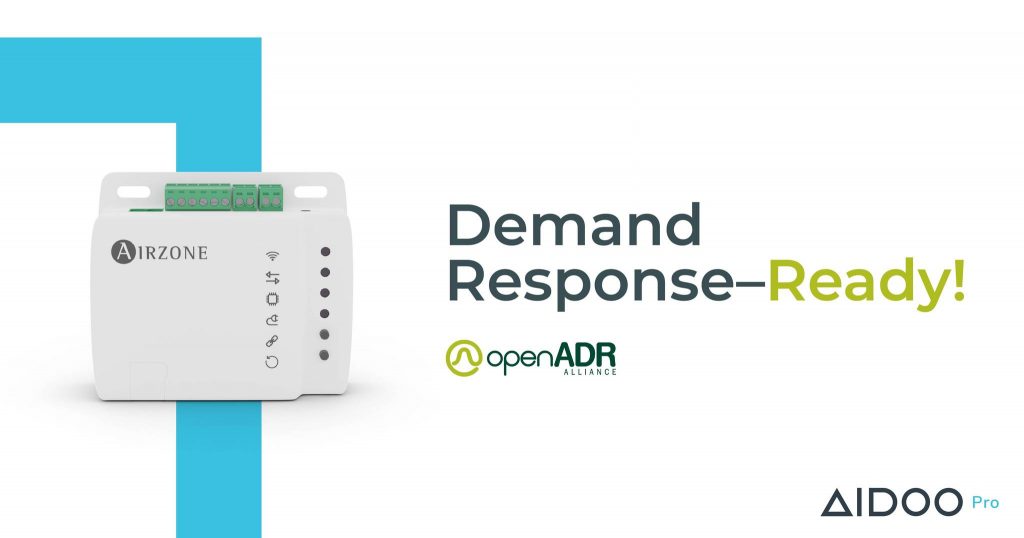
Airzone addresses this challenge with the Airzone Aidoo Pro, an HVAC integration gateway designed to sit between third-party control platforms and inverter-driven HVAC equipment.
Aidoo Pro:
- Translates between smart thermostat and home/building automation platform control signals and manufacturer-native protocols
- Preserves variable-speed performance when controlling an inverter HVAC unit with a third-party control device
The Airzone Aidoo Pro is compatible with leading smart thermostat brands like Honeywell Home, ecobee, and Nest, as well as every leading Inverter unit manufacturer. No matter what Inverter unit or smart thermostat you have, there’s an Airzone Aidoo Pro for you.
Demand Response for Smart Buildings
Though smart thermostats are the most common connection point between residential and light commercial HVAC systems, some utilities also offer platform-level demand response integration with home automation, building automation, or energy management systems. This allows MDUs, smart office buildings, or luxury smart homes to coordinate responses to DR events across multiple subsystems.
Instead of demand response commands like “raise the temperature by 2 degrees,” platform-mediated demand response signals express intents like:
- Reduce the building’s power load by a certain amount
- Shift power consumption earlier or later in the day
- Limit power ramp rates
The platform determines how to respond, coordinating HVAC, EV charging, water heating, blinds, and other subsystems to meet the objective.
OpenADR for Smart Buildings
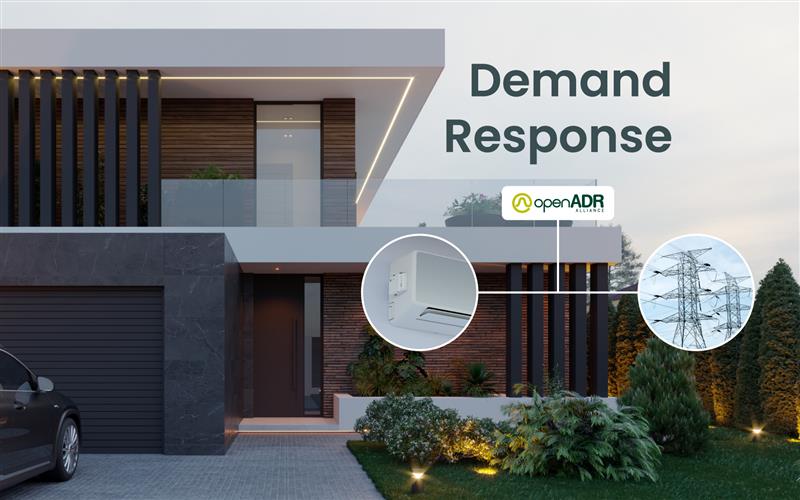
In platform-mediated demand response, the standardized signaling protocol OpenADR allows utilities or aggregators to communicate demand-response events in a consistent, vendor-neutral way. Rather than targeting individual devices, OpenADR enables building or home energy management systems to receive DR signals and translate them into coordinated actions across multiple subsystems.
When planning HVAC systems for smart buildings, look for integration devices that support OpenADR. Devices such as the Airzone Aidoo Pro, which is OpenADR-certified, can participate directly in these platform-mediated programs, supporting both today’s smart thermostat–based DR and tomorrow’s grid-interactive building strategies.
The Future of Demand Response
As buildings become more automated and electrified, demand response programs will reward flexibility, coordination, and interoperability. The Airzone Aidoo Pro is an essential demand response compatibility enabler for both smart thermostats and home/building automation platforms. Using this integration control gateway, HVAC professionals can deliver systems that reduce energy costs today while remaining compatible with the emerging demand response models of tomorrow.
If you want to build demand response capabilities into your next VRF or smart building project, check out the OpenADR-certified Aidoo Pro. The Aidoo Pro lookup tool at the bottom of the page will help you specific the right Aidoo model for your HVAC unit. Contact your Airzone Sales Rep to order.